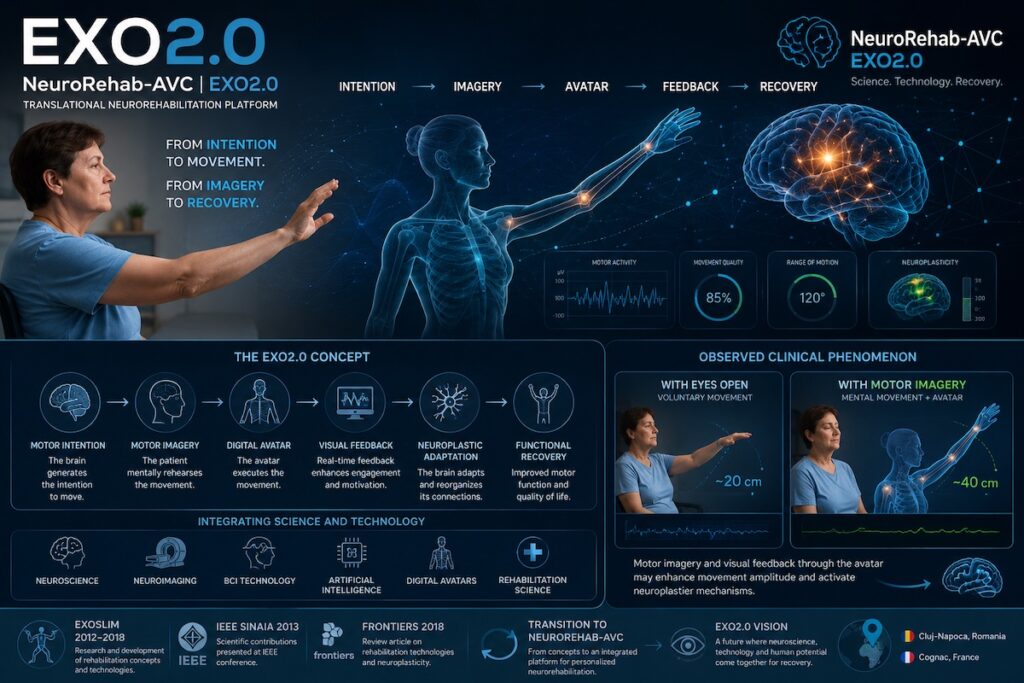
EXO2.0
From EXOSLIM to NeuroRehab-AVC
EXO2.0 represents the evolution of concepts and research directions initiated through the EXOSLIM project (2012–2018), focusing on the integration of rehabilitation technologies, neuroscience and personalized recovery strategies.
The current NeuroRehab-AVC initiative expands these concepts by incorporating advances in neuroimaging, motor imagery, artificial intelligence, digital avatars and adaptive rehabilitation systems.
Scientific Foundations
EXOSLIM Project (2012–2018)
The EXOSLIM project explored innovative approaches to rehabilitation and functional recovery through the integration of medicine, engineering and rehabilitation sciences.
The project generated scientific communications and interdisciplinary collaborations involving clinicians, engineers and researchers.
IEEE Sinaia 2013
The concepts developed within EXOSLIM were presented and discussed within the scientific community through contributions at IEEE conferences, including the 2013 IEEE conference held in Sinaia, Romania.
These early developments highlighted the potential of technology-assisted rehabilitation and personalized recovery pathways.
Frontiers 2018
Subsequent scientific work contributed to the publication of a review article in Frontiers (2018), consolidating knowledge regarding rehabilitation technologies, neuroplasticity and future directions for personalized recovery.
Motor Imagery and Neuroplasticity
Motor imagery represents the mental rehearsal of movement without overt physical execution.
Research suggests that motor imagery may activate neural networks involved in motor control and may contribute to neuroplastic adaptations during rehabilitation.
The NeuroRehab-AVC platform explores how motor imagery can be integrated into adaptive rehabilitation strategies, particularly for post-stroke recovery.
The Motor Avatar Concept
A central concept of EXO2.0 is the development of a digital motor avatar capable of translating motor intention, motor imagery and rehabilitation performance into visual and interactive feedback.
The avatar is envisioned as a bridge between neural activation, patient engagement and rehabilitation training.
Visual Feedback
Visual feedback plays an important role in motor learning and rehabilitation.
EXO2.0 explores how real-time visualization of movement, motor intention and rehabilitation progress may enhance patient motivation, training intensity and functional recovery.
Future Directions
Current development areas include:
- Neuroimaging biomarkers
- Motor imagery training
- Brain-computer interfaces (BCI)
- Digital rehabilitation avatars
- Adaptive artificial intelligence
- Personalized rehabilitation pathways
- Clinical validation studies
NeuroRehab-AVC | EXO2.0 is currently under scientific and clinical development.
The project seeks to promote collaboration between clinicians, psychologists, engineers, researchers and neurotechnology partners interested in advancing evidence-based neurorehabilitation.